What if the greatest vulnerability in your Lockout Tagout process is not the machinery, but the way it is managed?
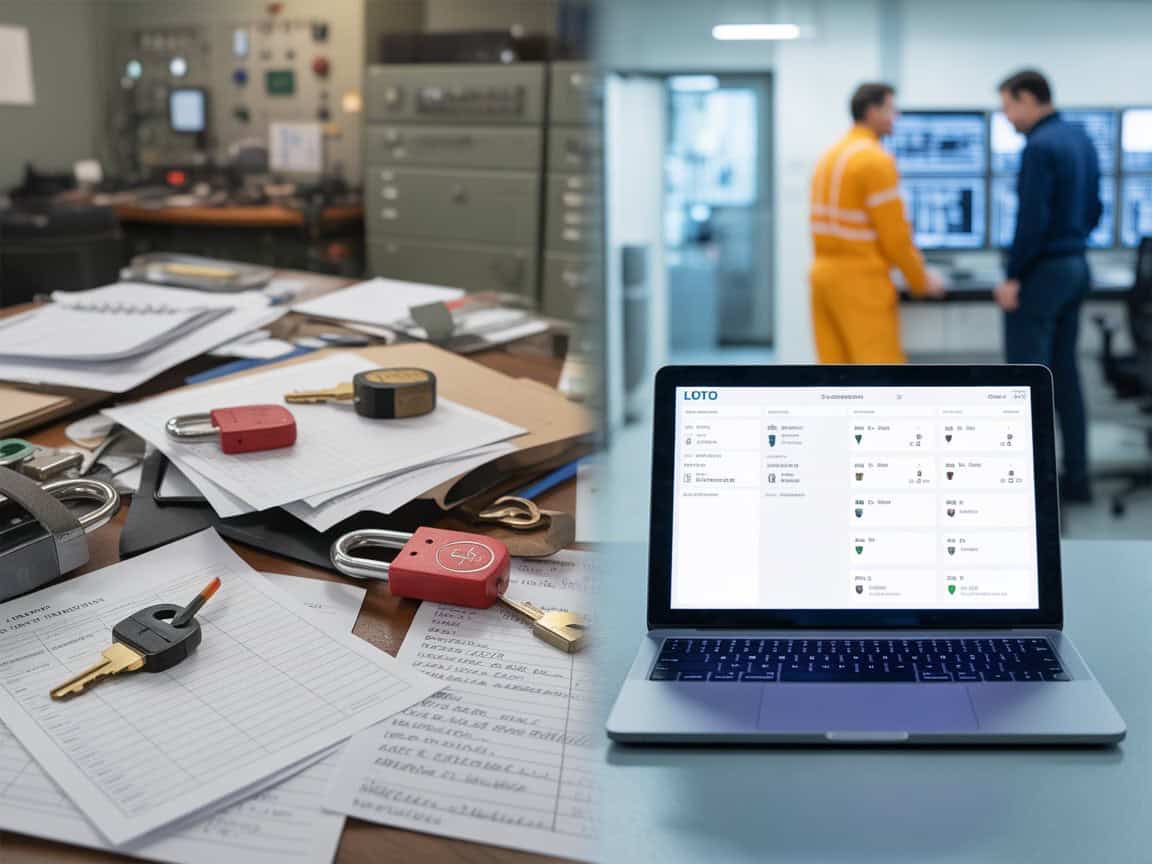
For decades, paper-based Lockout Tagout (LOTO) systems have supported hazardous energy control in industrial environments. Clipboards, printed permits, handwritten signatures and room logbooks became standard practice.
Industrial operations, however, have evolved.
Modern facilities are larger, energy systems are more complex, and teams operate across multiple locations simultaneously.
Paper-based LOTO processes were never designed to manage this level of operational complexity.
Procedural gaps begin to appear.
The Operational Limitations of Manual Lockout Tagout Systems
Traditional LOTO programs may be compliant in structure, but they are often fragile in execution. Most rely on:
- Static written procedures
- Manual approval routing
- Localized documentation storage
- Physical logbooks per room or area
Several operational challenges commonly emerge.
1. Limited Real-Time Visibility
Supervisors and safety leaders cannot easily view the isolation status of equipment across projects or zones without physically checking documentation or visiting site.
This restricts coordination and slows decision-making.
2. Inconsistent Execution Across Sites
When procedures are interpreted differently by teams or contractors, variations occur. Even small deviations weaken hazardous energy control.
3. Approval Bottlenecks
Manual signatures and paper routing delay work progression. In high-pressure commissioning environments, this creates tension between compliance and operational speed.
4. Audit Preparation Burden
During regulatory or client audits, records must be retrieved from multiple sources and consolidated manually.
In large facilities, logbooks may be stored per room or area, making verification:
- Time-consuming
- Inconsistent
- Vulnerable to missing records
5. Exposure to Human Error
Handwritten entries, misplaced forms, unclear documentation and informal shortcuts increase the likelihood of non-compliance.
Industry safety data consistently shows that failures in hazardous energy control remain a significant contributor to serious workplace incidents.
These are not paperwork issues.
They are operational risks.
Why Modern Industrial Facilities Require Structured Digital LOTO Control
Today’s industrial environments are digitally interconnected.
Engineering drawings are updated frequently.
Project documentation is centralized.
Operational workflows are increasingly integrated.
Yet in many facilities, LOTO management remains disconnected from this digital infrastructure.
Isolation identification often depends on individual interpretation of drawings. Each assessment requires manual revalidation by the energy marshal. Repetition increases variability and the potential for error.
Paper logbooks record what happened.
They do not provide active operational visibility.
In complex facilities, safety execution must align with the same structured control applied to production and engineering processes.
From Documentation to Governance
Digital Lockout Tagout systems fundamentally change the function of safety management.
The objective shifts from recording compliance to structuring and enforcing it.
Instead of static paperwork, a governed digital workflow embeds validation logic directly within the system architecture.
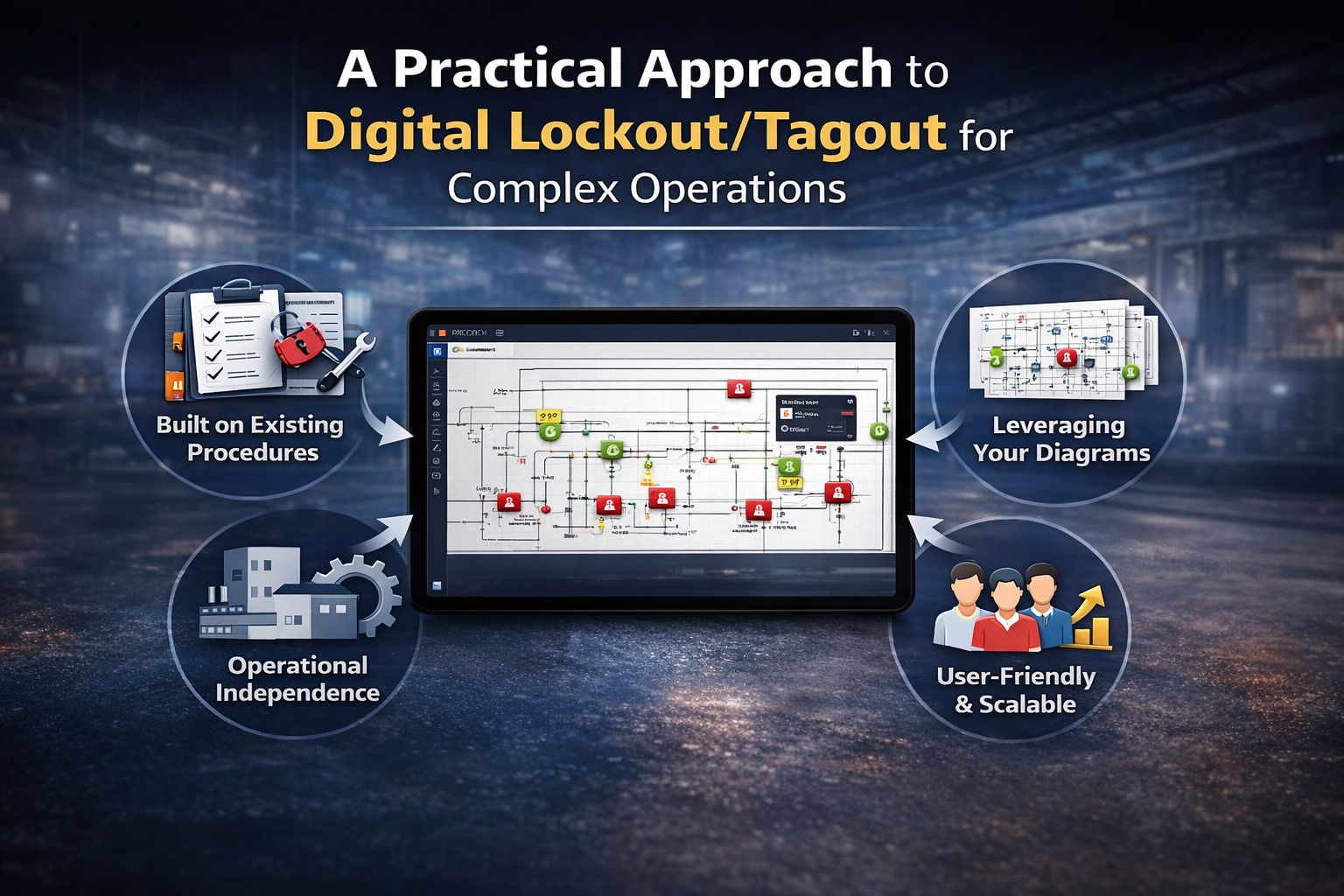
Isolation points can be mapped onto identifiable equipment symbols within uploaded technical drawings. These mapped points are visible to authorized users, enabling review, coordination and structured validation.
Selection becomes system-guided.
Workflow progression becomes condition-dependent.
Energization approval cannot proceed unless predefined isolation validation criteria are satisfied.
Ambiguity is reduced.
Informal interpretation is eliminated.
Safety becomes governed, not assumed.
Live Isolation Status and Energy Path Visibility
One of the most significant improvements in digital LOTO control is real-time isolation status visibility.
In traditional systems, confirmation typically requires:
- Physical inspection
- Cross-checking logbooks
- Verbal confirmation
Paper functions as a historical record, not a live operational tool.
Digital platforms provide immediate visibility of isolation state directly on technical diagrams.
Safe and unsafe zones can be represented according to:
- Energy path logic
- Isolation status
- Role-based authorization state
This improves coordination between:
- Contractors
- Commissioning teams
- Operational staff
In high-consequence environments, real-time clarity reduces the risk of miscommunication.
Standardization Across Projects and Organizations
Paper-based Lockout Tagout practices frequently vary between projects and sites. Even within the same organization, execution methods may differ based on local habits.
Digital workflow templates enforce consistency.
Sequential, role-based validation logic is embedded within the application architecture. Authority levels, reviewer roles and approval paths are clearly defined.
This ensures hazardous energy control procedures are applied consistently across all projects while maintaining full traceability.
Standardization strengthens compliance.
Continuous Audit Readiness
Compliance documentation should not be assembled only when an audit is announced.
In paper systems, preparing for external review often requires manual consolidation of records from multiple areas. This process is slow and vulnerable to inconsistencies.
In structured digital environments:
- Compliance dossiers can be generated directly from recorded workflow data
- Reports can be extracted by selected time intervals
- Historical logs remain accessible at any time
Audit readiness becomes continuous rather than reactive.
Reducing Organizational Risk
Failures in isolation control can result in:
- Serious injury
- Operational downtime
- Regulatory penalties
- Reputational damage
In mission-critical sectors such as data centers, energy infrastructure and advanced manufacturing, these risks carry significant financial implications.
Digital LOTO control does not replace safety professionals.
It strengthens their effectiveness by:
- Removing administrative friction
- Increasing visibility
- Enforcing structured validation
- Reducing procedural variability
Technology does not eliminate risk entirely.
Structured governance significantly reduces exposure.
Aligning Lockout Tagout with Digital Transformation
Industrial organizations are investing in automation, smart systems and data-driven operations.
Safety processes must evolve accordingly.
A modern Lockout Tagout program should provide:
- Clear visibility of isolation status
- Structured, role-based workflow enforcement
- Integrated diagram-level control
- Automatic compliance recording
- Centralized reporting and dashboard oversight
When safety management aligns with digital operational standards, organizations build resilience.
Modernizing Lockout Tagout is not about replacing established safety principles.
It is about strengthening them with tools designed for contemporary industrial environments.